

It began with the wind.
Not the howling sort, but a long, low breath that drifted through the Carpathian pines like a whispered omen. The road to Bran winds higher with every mile, cobblestones slick with mist, the forest leaning in close—as if trying to listen. And there, beyond the veil of fog and the hush of dying daylight, it appears. Perched atop a jagged hill, spires silhouetted in violet dusk, Bran Castle waits.
They say it has stood here for over 600 years, watching the centuries unravel, its stones absorbing the secrets of empires and executions alike. Whether it is truly Dracula’s Castle no longer seems to matter. The shadows are deep. The walls are cold—the stories… alive.
And when you walk through its heavy doors on Halloween night—when the veil is thin, and the old world breathes through the cracks—you do not merely visit a castle. You enter a legend.
Highlights
Why Bran Castle is the Ultimate Dracula Destination in Romania
Bran Castle, often referred to as “Dracula’s Castle,” is one of the most iconic haunted landmarks in Europe. Located in the heart of Transylvania, this 14th-century fortress is the centerpiece of vampire legends, ghost stories, and Halloween pilgrimages. While its connection to Vlad the Impaler remains debated, Bran Castle’s chilling atmosphere, medieval architecture, and supernatural lore make it a must-visit for those seeking paranormal Transylvania tours, Halloween ghost hunts, and dark tourism experiences in Romania.
Explore eerie corridors and candlelit chambers with centuries-old secrets
Join haunted tours, vampire-themed events, and overnight stays inside the castle
Discover the truth behind Dracula tourism and the myths of Vlad the Impaler
Visit nearby haunted sites like Poenari Fortress, Hoia Baciu Forest, and Corvin Castle
Whether you’re drawn by gothic architecture or ghostly encounters, Bran Castle promises an unforgettable mix of legend, history, and the unexplained.
Legend Meets Reality: What Visitors Expect of Bran Castle
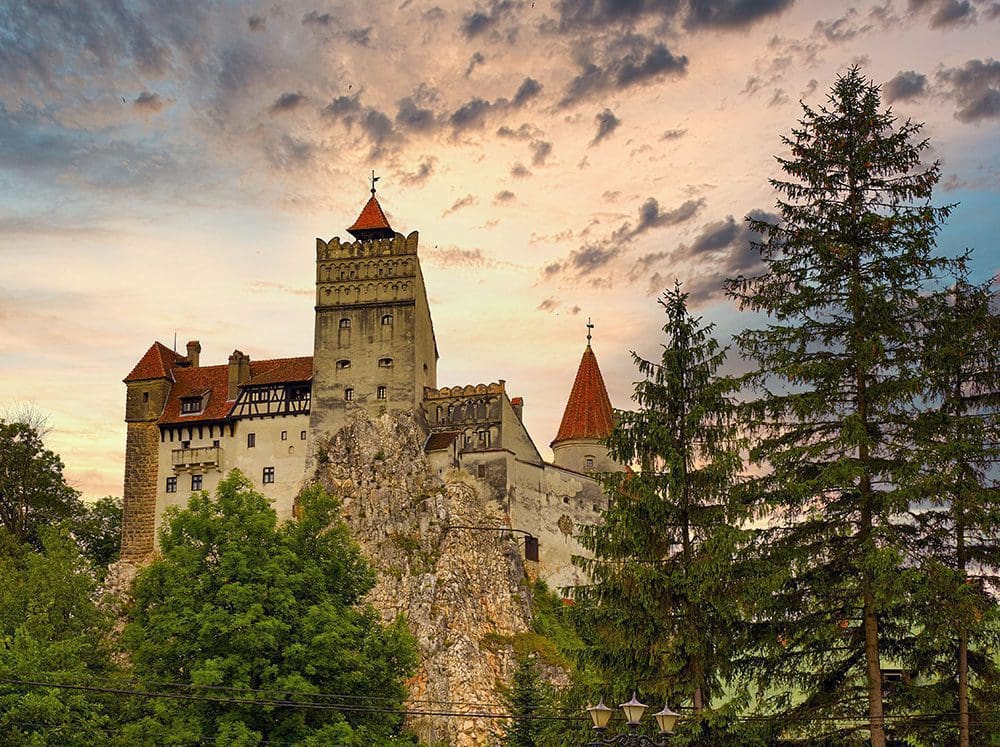
When travelers hear “Dracula’s Castle,” they often envision something lifted straight from the pages of Bram Stoker’s imagination: towering black spires, thunder crashing overhead, and a fanged figure silhouetted against the moon. Bran Castle has become a vessel for myth—a place where the lines between fantasy and history blur like mist over the Carpathians.
There’s a gothic pulse to the structure that cannot be denied. Its medieval towers, winding staircases, and narrow stone corridors seem made for secrets. And indeed, that’s what draws most visitors: not just to see it, but to feel it. To brush up against the lore. To walk where legends might have walked.
In the global imagination, Bran Castle is the notorious home of Vlad the Impaler—Stoker’s grim muse. While historical records don’t support the idea that Vlad ever lived there, the myth has been persistent, potent, and strangely poetic. For those seeking paranormal Transylvania tours, this castle is ground zero—a place steeped in psychic residue, ancestral whispers, and an atmosphere thick enough to stir the soul.
Yet when visitors step inside, they’re often struck not just by the darkness, but by the intimacy. The rooms are modest in size. The fireplaces are well-worn. The creak of each floorboard feels like a memory awakened. You come looking for monsters—and find history instead. But it’s the feeling that lingers. The sense that something unseen still resides here.
And for many, that’s what makes Dracula Castle unforgettable: it doesn’t need to match the myth. It is the myth.
Bran Castle Through History: Fact or Fiction?
Long before it was ever whispered about as Dracula Castle, Bran stood as a sentinel at the crossroads of empire and invasion. Constructed in 1377 by the Saxons of Kronstadt (modern-day Brașov), the fortress was authorized by Hungarian King Louis I to defend against Ottoman incursions and to secure a strategic mountain pass through the Carpathians.
Its role was military, not mythical. The castle’s steep stairways, arrow slits, and watch towers were designed for defense, not for housing a bloodthirsty count. Yet over centuries, Bran evolved—from stronghold to customs post, then to royal residence. In the 1920s, Queen Marie of Romania transformed it into a beloved home, filling its stony rooms with warmth, art, and refinement.
So, where does Vlad the Impaler enter the story?
Here’s the strange truth: there’s no definitive evidence that Vlad III ever lived in or ruled from Bran Castle. At best, historians suggest he may have passed through the area or been briefly imprisoned nearby. But the association between Vlad and Dracula Castle was a masterstroke of 20th-century tourism—and a reflection of the castle’s naturally haunting aesthetic. High on a cliff, shrouded in mist, Bran looks like it was made for monsters.
And therein lies the enduring power of the place. Even if Vlad never slept within its walls, even if Bram Stoker never named it in his novel, the synergy between fiction and fact persists.
Today, for those embarking on paranormal Transylvania tours, Bran Castle remains a site of layered realities. It’s a place where geopolitical history, royal heritage, and shadowy legend coexist—each part equally vital to its mystique.
How the Dracula Myth Took Root

For all its infamy, Dracula’s Castle was never penned into Bram Stoker’s manuscript.
Stoker, the Irish author of the 1897 gothic masterpiece Dracula, never visited Romania. His understanding of Transylvania came secondhand—from travel books, maps, and letters. His Count Dracula’s castle is described as perched high above a winding river gorge, atop a cliff with a commanding view and a treacherous path. While that imagery evokes Bran Castle to modern eyes, it was purely coincidental.
In fact, no real-world location is ever named in Dracula. Stoker’s fictional castle likely drew inspiration from the descriptions in Charles Boner’s Transylvania: Its Products and Its People (1865) and Emily Gerard’s The Land Beyond the Forest (1888). Both mentioned the wild beauty of the Carpathians and the region’s dark folklore—but never Bran specifically.
So how did Bran Castle become synonymous with Dracula?
In the late 20th century, Romanian tourism officials recognized an opportunity. With its brooding towers, steep walls, and mountaintop silhouette, Bran Castle offered a ready-made stage for Gothic drama. Despite no direct connection to Stoker or Vlad, it became branded as Dracula’s Castle, a title it still wears like a velvet cloak.
Visitors on paranormal Transylvania tours aren’t necessarily misled—they’re stepping into a myth built over decades. What they find is a castle that captures the essence of Dracula, even if it was never his home. The fiction has become folklore, and the legend lives on in every creaking hallway and flickering shadow.
Discover more about our lineup of Halloween tours for your next Fall Equinox trip HERE!
To keep up with our blog and other Mysterious Adventures offers, sign up for our newsletter HERE!
Paranormal Tourism at Bran: What Do Travelers See?
For many who visit Bran Castle, curiosity about Dracula leads them down dim corridors only to find more than architectural splendor—they find a palpable energy. Guests regularly describe:
- Sudden drops in temperature, even in rooms warmed by the sun
- A persistent feeling of being watched, as if unseen eyes trace their steps
- Thoughts of shadowy figures glimpsed at the edge of vision, never fully seen but never forgotten.
The White Lady and the Mournful Monk
Within the castle’s stone walls are legends that have become embedded in its identity:
- The White Lady, often spotted drifting near the courtyard or chapel, is said to be a noblewoman—or perhaps a scorned lover—forever undone by sorrow. Her presence lingers as silent sorrow, chilling the air around her.
- In a narrow chapel corridor, visitors report whispers and light touches they attribute to a monk reputedly bricked alive within the walls—a restless spirit tied to betrayal and mourning.
Playful or Painful? The Children’s Laughter
One of the more unsettling tales involves the laughter of children echoing through the courtyard—those believed to have perished during a past siege. Witnesses describe fleeting noise, ghostly games, and eerie giggles that fade when approached.
Tools of the Supernatural Trade
Paranormal investigation teams have ventured into Bran Castle armed with modern tools, and they’ve documented:
- Orbs of light caught in the corners of photographs
- Electronic Voice Phenomena (EVP)—indistinct whispers recorded within the fortress
- Reports of unseen presences moving beside and behind investigators through shadowed hallways.
While skeptics may chalk these up to imagination or ambient castle echoes, the stories persist. For many, the experience of stepping into Bran past twilight is enough to sense something ancient stirring.
Why Tourists Flock to the Supernatural
Bran Castle’s allure isn’t just in its link to Dracula—though the legend certainly draws eager crowds. It’s the emotional resonance of exploring a site layered in history, myth, and lingering energy. Many visitors confirm:
- That Bran Castle’s gothic architecture and confined corridors amplify the uncanny
- That the Horror Exhibit: “A History of Dreads in Transylvania” further enhances the experience, combining ethnographic history with modern light-and-sound installations on local mythological creatures like the Strigoi and Werewolves.
Why It Matters for Travelers
If you're seeking paranormal Transylvania tours, Bran Castle delivers more than scenery—it invites you into the realm of the unexplained. Whether or not Dracula ever walked its halls, the atmosphere is unmistakably charged. Between creaking floorboards, whispered histories, and inexplicable sensations, the castle becomes more than a backdrop: it becomes a character in its own ongoing myth.
Every visitor leaves with a question: What did I just feel? And sometimes, did I leave something behind?
Exploring the Surroundings: Transylvania’s Supernatural Landscape

Step beyond the torches and portcullises of Bran Castle into a world where legend seeps through every stone and shadow. Transylvania’s supernatural landscape stretches far beyond the gothic silhouette of its most famous fortress—into haunted woods, ancient citadels, and medieval towns that seem to speak in whispers of another realm.
🏰 Rasnov Fortress & Corvin (Hunyad) Castle
Just a winding road away from Bran lies Râșnov Fortress, overlooking forests heavy with story and despair. Here, Turkish prisoners were tasked with digging a 143‑meter well under the promise of freedom. Many died in the process, some carving verses of the Quran into the stone wall before vanishing. Their bones were later found at the bottom—silent tombstones beneath the echo of legend.
Nearby, Corvin (Hunyad) Castle shares a similar tapestry of myth. The prisoners’ names scrawled on well walls speak not only of betrayal but of curses cast deep into stone. Both castles continue to attract seekers of historical truth and paranormal resonance—ancient architecture steeped in memory and menace.
🌲 Hoia-Baciu Forest: Transylvania’s Bermuda Triangle
If Bran Castle is the heart of Transylvania’s myths, then Hoia-Baciu Forest is its soul. Located near Cluj‑Napoca, this forest is infamous for UFO sightings, electromagnetic anomalies, and visitors experiencing physical sensations after entering.
At the center lies “The Devil’s Heart,” a 1‑km clearing devoid of vegetation—a vegetative void that scientists and storytellers alike struggle to explain. Apparitions, orbs, whispers, disappearances, and inexplicable sensations abound here. Some believe this forest shelters interdimensional rifts or portals.
🏰 Poenari Castle: The Real Residence of Vlad
Perched high above the Argeș Valley on an 800‑meter cliff, Poenari Castle served as Vlad the Impaler’s fortress—not Bran Castle. Accessed via nearly 1,500 steps, its stone walls guard the brutal truth of Vlad’s reign. Legend claims Vlad’s wife threw herself to death rather than face capture; visitors have since reported orbs of light, floating phenomena, and lingering shadows on its grounds.
Though less visited than Bran, Poenari is widely regarded by historians as Vlad's authentic stronghold—a raw, windswept structure dripping with history far beyond fiction.
🏰 Sighişoara & Medieval Towns of the Region
Sighișoara—birthplace of Vlad Tepes—is a living time capsule. Cobblestone streets, pastel facades, and a 14th‑century clock tower lead into a Halloween spectacle each year. Locals and tourists gather in gothic dress, and storytellers recount terrifying truths alongside breathless myth under moonlit skies.
Other villages—like Bănița, Bonțida (home to Banffy Castle), and Prejmer—hold their own spectral lore. Banffy is haunted by war ghosts and apparitions stirred by Nazi-era destruction. Prejmer’s fortified church stands sentinel over centuries of Saxon memory and collective fear
Why It Still Draws Visitors: The Allure of Dracula Tourism
There’s something timeless—and undeniably human—about our fascination with darkness. Dracula tourism taps into that primal intrigue. Why do we still flock to ancient castles in fog-laced mountains? Why does the image of a vampire, centuries after Bram Stoker’s pen first gave it shape, still haunt our cultural psyche?
The Psychology Behind the Vampire Myth
Vampires represent a paradox we secretly crave: deathlessness wrapped in decadence. The idea of an immortal who feeds on life, yet remains seductively human, mirrors our own fear of death and obsession with power. It’s no surprise then that Bran Castle—mistaken or not as “Dracula’s Castle”—becomes a pilgrimage site. It’s less about accuracy and more about tapping into a narrative that lives inside us all: our desire to confront darkness without being consumed by it.
Psychologically, vampire myths allow us to safely explore themes of desire, taboo, transformation, and loss. Standing in Bran Castle is standing inside that liminal space where history, fear, and fantasy collide.
The Gothic Architecture: A Story in Stone
The architecture of Bran Castle itself fuels the mystique. Built in the late 14th century, its medieval towers, narrow stairwells, and candlelit chambers evoke a sense of claustrophobia and awe. This aesthetic, now known as Gothic Revival, whispers of a time when superstition reigned and shadows were believed to hold secrets.
Travelers come not just to tour the castle, but to feel it—its weight, its stories, its atmosphere. And that is the brilliance of supernatural tourism: it isn’t about viewing, it’s about experiencing.
The Supernatural as Escape and Connection
In an era of digital noise and concrete logic, paranormal Transylvania tours offer something rare: immersion. It begins as soon as you step off the plane; you will feel that you have stepped into myth. You will sleep in castles and walk the same cobblestones as medieval knights and local legends. Will you hear the whispers in the dark?
But perhaps more than escape, these journeys offer reconnection: to wonder, to curiosity, to ancestral fears and sacred rituals long buried under modernity.
FAQs & Booking Info for Paranormal Transylvania Tours

What’s the best time to visit Dracula Castle?
Late October is one of the best times, and dare we say the most mystical times to visit. As there is an atmosphere or magic that hangs in the air, you have Halloween expeditions and ghost hunts, and the feeling of the veil thinning is palpable.
For quieter visits, early morning hours before crowds arrive provide solitude.
What tours include Bran Castle overnight experiences?
- Dracula’s Haunted Halloween Romania Tour with Dacre Stoker (12‑day immersive itinerary) includes a private Vampire Ball and castle overnight ghost hunt.
- Other Dracula Castle Halloween Party options offer shorter stays featuring night tours and festive events.
Are local ghost-hunting or storytelling events included?
Yes. Typical itineraries include haunted forests, cemeteries, the Witches’ Pond, Hoia Baciu, Poenari Fortress, and evening ghost hunts led by investigators or local guides.
Where do travelers stay?
Both tours offer 3–4★ accommodations in Bran or nearby Brașov—usually walking distance to the castle and with traditional Transylvanian meals included.
So, are you ready to step beyond legend and into Dracula’s Castle? Join Mysterious Adventures Tours for a supernatural, paranormal Transylvania tour that goes beyond tourist paths. Book your Dracula’s Haunted Halloween pilgrimage or inquiry today—and let the mist-shrouded past pull you into your next adventure.

Embark on a mysterious adventure with us!
Explore divinely selected places, where enigma thrives in every corner. From lands vibrating with mystique to ancient realms echoing with phantom tales, our Mysterious Adventures await. Join the journey and unravel the secrets of the extraordinary.