

Everyone knows the rules. A vampire can’t come in unless you invite it. It hates garlic. It has no reflection, it burns in sunlight, and it can only be stopped with a stake through the heart.
These rules feel ancient, as if they were handed down unchanged from some Transylvanian village centuries ago. The truth is stranger and more interesting.
Some of the rules really are old, rooted in village burial customs, seasonal rituals, and real fear of disease. Others were invented or reshaped by a Victorian novelist and a silent film. And a few of the oldest rules have almost disappeared from popular memory. In those older stories, vampires were compelled to count spilled seeds, and families buried their dead with sickles across their throats.
This guide untangles the old vampire rules: where each came from, what it originally meant, and the places you can travel to find the folklore behind them. Most of those places are in Romania and New Orleans.
Key Highlights
- The “classic” vampire rules come from two different sources. Eastern European folk belief supplied garlic, grave rituals, and seed-counting. Fiction, especially Bram Stoker’s Dracula (1897) and the film Nosferatu (1922), popularized mirrors, invitations, and deadly sunlight.
- The folkloric vampire looked nothing like Count Dracula. It was usually a recently deceased neighbor blamed for sickness or misfortune, not an aristocrat in a cape.
- Romania keeps some of these traditions alive. Garlic on doors and windows remains part of Saint Andrew’s Night, often called Romania’s Halloween.
- New Orleans built its own vampire legends, from the Casket Girls of the Ursuline Convent to the mysterious Jacques St. Germain.
- You can experience both destinations on Mysterious Adventures Tours’ Dracula Halloween tours in Romania and the Haunted New Orleans & Halloween at Sea journey.
Folklore vs. Fiction: Two Kinds of Vampire
Before looking at the rules one by one, it helps to know that there are really two different vampires.
The folkloric vampire belongs to the villages of Eastern and Central Europe. In Romania it was called the strigoi or moroi. In Poland it was the strzyga, and in Serbia and Greece it had other names. It was a restless dead person who returned to trouble family and neighbors, often blamed when illness spread, livestock died, or a household suffered one misfortune after another. Folklorist Paul Barber’s influential study Vampires, Burial, and Death shows how much of this belief grew from people trying to make sense of death, decomposition, and disease.
The literary vampire arrived much later. When Bram Stoker published Dracula in 1897, he blended folklore he’d read about with gothic fiction and Victorian anxieties. He created the elegant, aristocratic predator the world now pictures. Stoker never traveled to Romania, but his novel permanently tied Transylvania to the vampire in the popular imagination.
Many of the rules we think of as “old” sit somewhere between these two traditions.
The Old Vampire Rules and Where They Came From
Rule 1: Garlic Keeps Vampires Away
This is one of the rules with genuine folk roots, and it’s still practiced in Romania today.
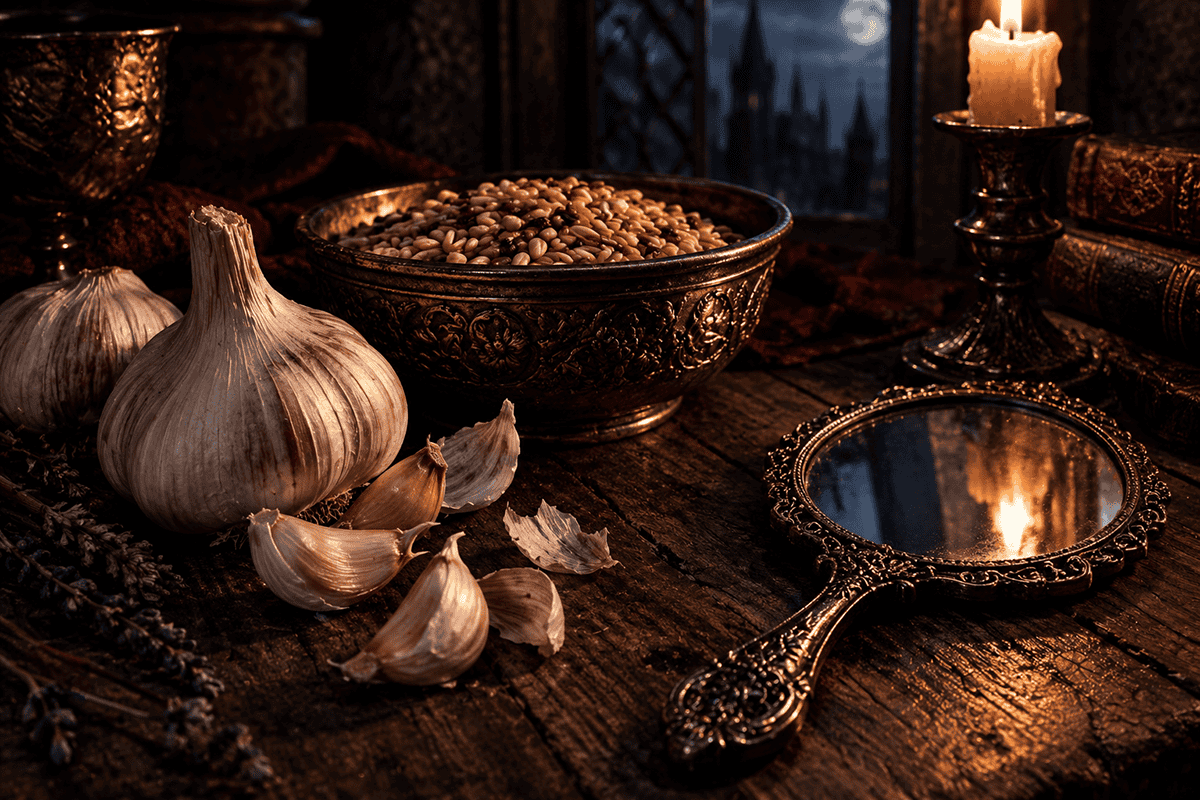
The night of November 29–30, the eve of the feast of Saint Andrew, Romania’s patron saint, is marked by customs and superstitions of pre-Christian origin meant to protect people, homes, and animals. Many Romanians regard it as their equivalent of Halloween, a night when spirits roam and garlic is used against evil and spells. Traditionally, garlic is placed on windows and doors and even inside animal stables. Folklore holds that living and dead strigoi appear on the night before St. Andrew’s Day, and the “guarding of the garlic” is one of the traditions linked to that night.
Garlic’s protective reputation stretches across many cultures, where it was used as medicine, as a purifier, and as a barrier against illness and evil. It’s easy to see how a plant believed to ward off sickness became a plant believed to ward off the dead who were blamed for sickness.
Travel tip: In Transylvania, you’ll still find garlic woven into menus, market stalls, and local humor. Mysterious Adventures travelers even stop for lunch at a restaurant called Garlic Bistro in Cluj-Napoca.
Rule 2: A Vampire Must Stop and Count
This is one of the oldest and most overlooked vampire rules.
In parts of Eastern European folklore, villagers scattered poppy seeds, millet, or grain on a suspected vampire’s grave or across their own doorsteps. The belief was that the vampire would be compelled to count every seed, which kept it busy until dawn. Similar stories appear elsewhere in the world, including tales of spirits forced to count grains of rice.
Psychologists have a word for an obsessive need to count: arithmomania. Folklore got there first. It’s also why many people suspect the Count on Sesame Street is a cheerful descendant of a much darker tradition.
Rule 3: Keep the Dead in the Grave
Long before stakes through the heart became a movie cliché, the most important vampire rule was simple: make sure the dead stay buried.
Archaeologists have found striking evidence of this. In 2022, excavations of a 17th-century cemetery in the Polish village of Pień uncovered the grave of a young woman. According to The Past, she had been buried with an iron sickle placed around her neck and a padlock on the big toe of her left foot. The excavation leader described these as “anti-vampire procedures.” In Slavic folklore, a sharp blade like a sickle could decapitate the dead if they tried to rise.
The lead archaeologist was careful about what the find means. He preferred to describe the practices as anti-vampire procedures rather than proof that the community believed she was a vampire. He suggested the woman may have had a physical impairment or mental disorder that led neighbors to fear her after death.
Earlier, at a cemetery in Drawsko, Poland, Smithsonian Magazine reported that researchers found one woman buried with a sickle across her pelvis, a rock on her neck, and a coin in her mouth, while four others had sickles laid across their throats.
These graves are a reminder that the old vampire rules weren’t entertainment. They were real responses to fear, grief, and the unexplained.
Rule 4: A Vampire Cannot Enter Uninvited
The invitation rule is one of the most famous, and one of the hardest to trace.
Folk traditions around the world treat the threshold as a spiritual boundary. People have long placed protective objects above doors, carried brides across thresholds, and held rituals at the entrance to the home. Stoker’s Dracula turned that general idea into a specific rule: the Count cannot enter a household the first time unless someone inside invites him. Later films and novels made it a fixed part of vampire lore.
Whether the idea is ancient or Victorian, it plays on a very old fear: the danger lies with whoever you let in.
Rule 5: Vampires Cannot Cross Running Water
Stoker also wrote that his vampire could cross running water only at certain moments of the tide. The idea echoes older European beliefs that witches and evil spirits couldn’t cross flowing streams. Robert Burns used that belief in his 1791 poem “Tam o’ Shanter,” where the hero escapes pursuing witches by reaching the middle of a bridge.
Running water has long symbolized purification and boundaries between worlds, so it makes sense that it became a barrier against the dead.
Rule 6: No Reflection in a Mirror
The missing reflection is mostly a literary invention, though it draws on older ideas. Many cultures associated mirrors with the soul, and covering mirrors in a house where someone had died was a custom in various traditions. Stoker gave his vampire no reflection, and the image stuck.
In village folklore, a strigoi was more often identified by its behavior or by the condition of its body when exhumed than by a mirror test.
Rule 7: Sunlight Destroys Vampires
This is the rule most people assume is ancient, and it is actually one of the newest.
In Stoker’s novel, Dracula can move around during the day, though his powers are weakened. The idea that sunlight destroys a vampire was popularized by the 1922 silent film Nosferatu, whose vampire perishes at dawn. Film after film repeated the idea until it felt like folklore.
Folkloric vampires were creatures of the night, but the vampire destroyed by sunlight owes more to cinema than to village tradition.
America Had Vampire Rules, Too
The old vampire rules crossed the Atlantic. In 19th-century New England, families watching loved ones waste away from tuberculosis sometimes believed a dead relative was draining the living. The best-known case is Mercy Brown of Exeter, Rhode Island. Her 1892 case is one of the best documented instances of a corpse being exhumed to perform rituals against an undead presence, and it was part of what’s now called the New England vampire panic. Smithsonian Magazine’s account of the panic shows how grief, disease, and folk belief combined in communities that were otherwise thoroughly modern.
Where the Old Vampire Rules Still Live: Romania
If there’s one place to walk into the world of the old vampire rules, it’s Romania. This is where folklore, fiction, and history overlap more thoroughly than anywhere else on Earth.
Bran Castle
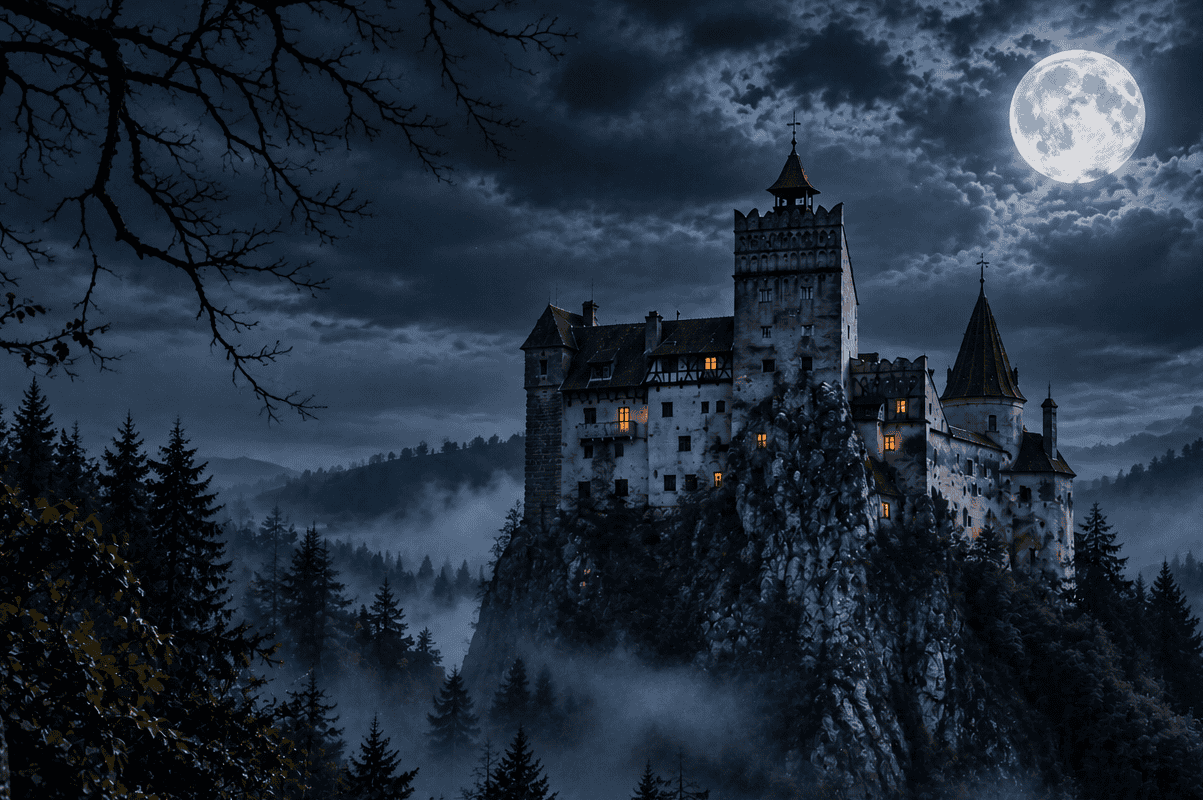
Perched above the Bran Pass, Bran Castle is the landmark most travelers call “Dracula’s Castle.” Its connection to the historical Vlad III, known as Vlad the Impaler, is slim. Its connection to the Dracula legend, however, is permanent. It remains one of the most atmospheric castles in Europe and the heart of Romania’s vampire tourism.
Sighișoara
This UNESCO-listed medieval citadel is the birthplace of Vlad III, the ruler whose family name, Dracula, Stoker borrowed. The house believed to be his birthplace, Casa Vlad Dracul, still stands inside the citadel walls.
Poenari Citadel
For travelers who want the “real” Dracula fortress, Poenari is it. The ruin of Vlad’s stronghold sits high above the Argeș Valley and is reached by a climb of about 1,480 steps.
Hoia Baciu Forest
Just outside Cluj-Napoca, Hoia Baciu Forest has a reputation as one of the world’s most mysterious forests. Its twisted trees are the subject of stories about strange lights and unexplained experiences.
Saint Andrew’s Night
Travelers visiting in late November may encounter the garlic traditions of Saint Andrew’s Night firsthand. It’s a living example of the old vampire rules still shaping everyday life.
Travel Romania’s Vampire Legends With Dacre Stoker
Mysterious Adventures Tours’ Dracula Halloween Romania Tour is hosted by Dacre Stoker, an internationally bestselling author and the great-grandnephew of Bram Stoker. The 12-day journey runs October 27 – November 7, 2026. Its highlights include:
- An exclusive Halloween Vampire Dinner and Ball inside Bran Castle
- A private two-hour paranormal investigation after dark inside Casa Vlad Dracul in Sighișoara
- An evening investigation in Hoia Baciu Forest with a local expert
- Private after-hours access to Corvin Castle once it closes to the public
- The climb to Poenari Fortress
Prefer a shorter trip? The 5-day Dracula Halloween tour and the standalone Dracula’s Vampire Ball at Bran Castle include the same Vampire Ball night. For next year, the 7-day Dracula’s Haunted Halloween Romania Tour runs October 27 – November 2, 2027. It includes a ritual experience at the Witches’ Pond, Peleș and Cantacuzino castles, Brașov, the Bran Castle Vampire Ball, and a private investigation at Casa Vlad Dracul.
Want more on Romania’s legends? Read our guide to Dracula, Frankenstein & Krampus tours.
Where the Old Vampire Rules Went West: New Orleans
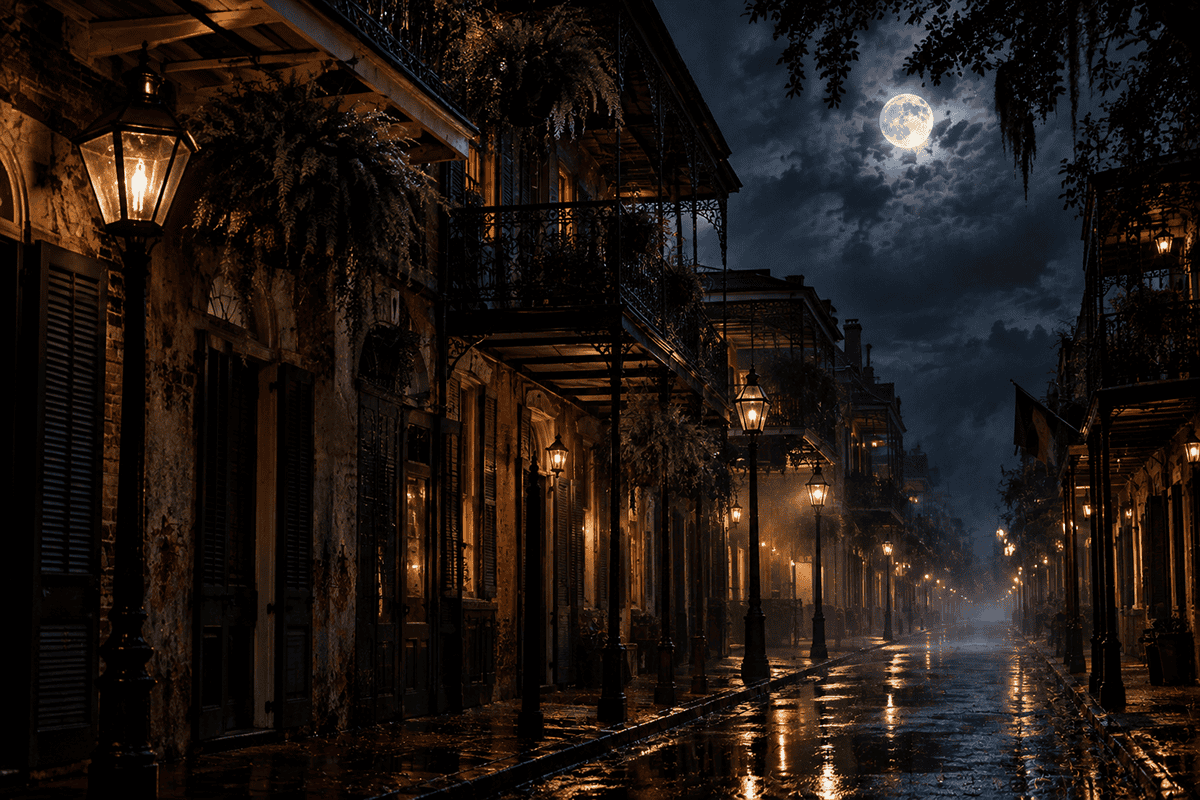
If Romania is where the vampire was born, New Orleans is where it moved in, settled down, and became part of the neighborhood.
The Casket Girls of the Ursuline Convent
New Orleans’s oldest vampire legend begins with real history. In 1728, young French women arrived in the colony as prospective brides for settlers. They were called les filles à la cassette, the casket girls, after the small coffin-shaped chests that held their belongings.
The women stayed at the Ursuline Convent in the French Quarter, and legend claims their trunks were stored on its upper floor. Over time, storytellers decided the trunks held something other than linens. Today, guides point to the convent’s third-floor shutters and note that they always stay closed.
The history and the legend are easy to separate. The casket girls were real and their arrival is well documented, but the idea that their luggage carried the undead is a New Orleans invention. The Old Ursuline Convent still stands at 1100 Chartres Street and is the oldest surviving building in the Mississippi River Valley.
Jacques St. Germain and Royal Street
Another French Quarter legend centers on Jacques St. Germain, a charming, mysterious gentleman said to have lived on Royal Street in the early 1900s. According to the story, he never seemed to eat and vanished after a disturbing incident at his home. Guides still stop along Royal Street to tell his tale.
Anne Rice’s New Orleans
Anne Rice’s 1976 novel Interview with the Vampire did for New Orleans what Stoker did for Transylvania: it made the city’s cemeteries, courtyards, and gaslit streets feel like a natural home for the undead. For many travelers, the city’s vampire mystique begins with her books.
For more on the city’s darker side, read 5 Chilling Tales from the Haunted City of New Orleans and The Most Haunted Places in the USA.
Experience Haunted New Orleans at Halloween
Mysterious Adventures Tours’ Haunted New Orleans & Halloween at Sea is a 10-day journey that runs October 23 – November 1, 2027. The trip opens with guided time in the French Quarter. Two supernatural-themed experiences on the second day may include haunted history, legendary cemeteries, vampire folklore, Voodoo traditions, or historic mansions, followed by an investigation-style evening designed exclusively for Mysterious Adventures guests.
From there, the celebration continues at sea. Travelers board Carnival Liberty for Carnival’s Halloween-themed cruise to Key West, Celebration Key, and Nassau. Stops include a visit to meet Robert the Doll in Key West and a private guided visit to Fort Charlotte’s dungeons in Nassau, and the trip ends with Halloween night at sea.
Can’t wait until next October? New Orleans also anchors Krampus Rising, the December journey in the America’s Shadowlands Weekends series. Explore America’s Shadowlands Weekends.
Why the Old Vampire Rules Still Matter
It’s tempting to dismiss vampire rules as superstition. But each one tells us something about the people who followed it.
Garlic on the windows shows a household trying to protect itself during the darkest part of the year. Seeds on a grave show a community that preferred to delay a threat rather than destroy it. A sickle across a young woman’s neck shows how fear and grief could turn into cruelty toward someone who was different. And a closed shutter on a New Orleans convent shows how a city turns its history into a story it can tell forever.
As we explored in Why We Love to Be Scared, the thrill of a legend is often a doorway into the history behind it. You don’t have to believe in vampires to find meaning in the rules people made to survive them.
Walk Where the Legends Began
There’s a difference between reading about the old vampire rules and standing in the places that shaped them. You can climb to Vlad’s fortress, dine by candlelight inside Bran Castle on Halloween, or stand on Chartres Street looking up at shutters that have stayed closed for generations.
Mysterious Adventures Tours designs small-group journeys that put history first and leave room for the unexplained, with expert hosts, curated after-hours access, and fellow travelers who share your curiosity. Solo travelers are welcome, and payment plans are available on many tours.
Ready to meet the legend?
- Join the Dracula Halloween Romania Tour with Dacre Stoker
- Reserve Haunted New Orleans & Halloween at Sea
- Browse all Halloween Tours
Frequently Asked Questions About Vampire Rules
What are the old rules of vampires?
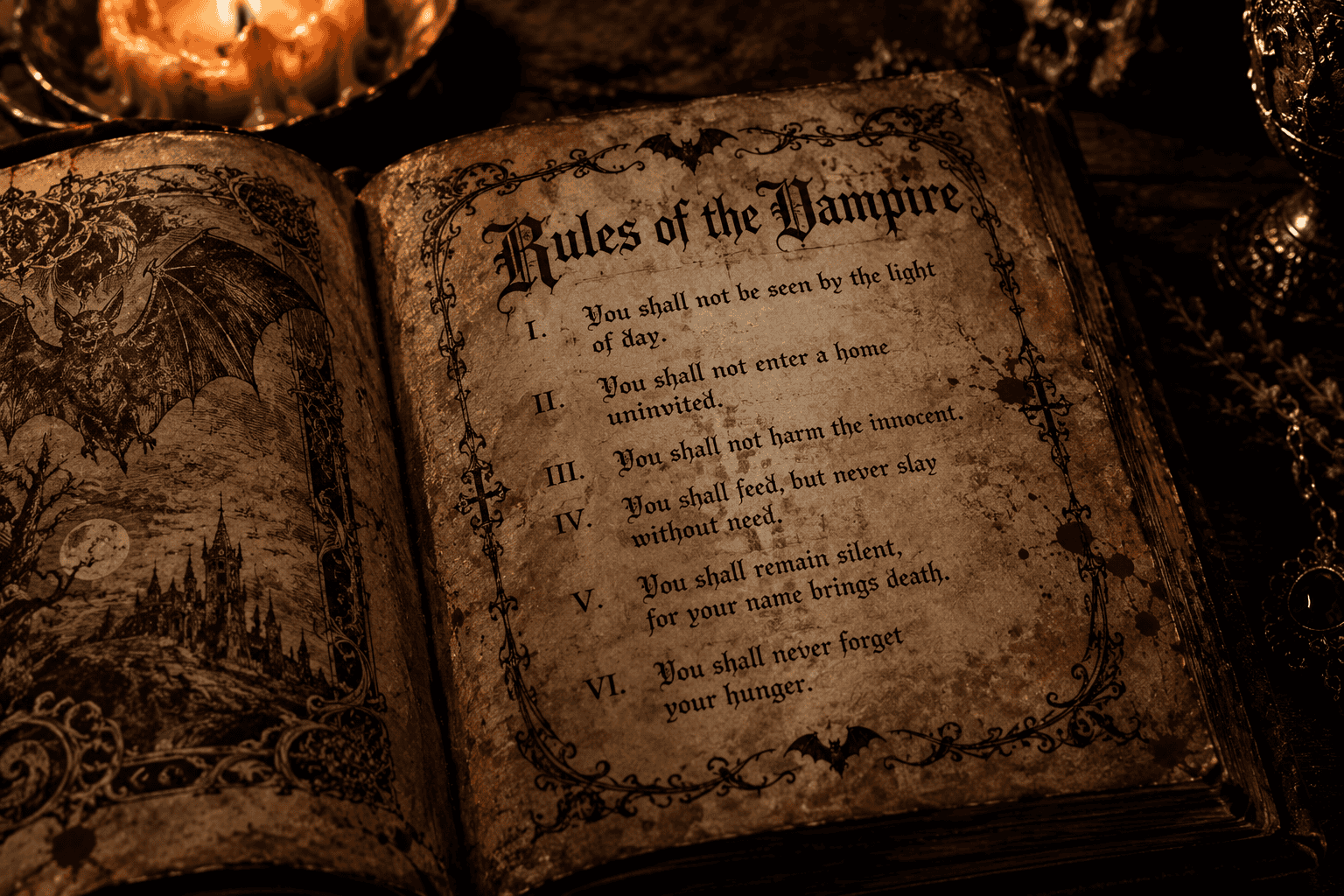
The best-known vampire rules are that vampires must be invited in, are repelled by garlic, cannot cross running water, have no reflection, and are destroyed by sunlight or a stake through the heart. Older European folklore adds lesser-known rules, including the belief that vampires were compelled to count scattered seeds and that the dead could be kept in their graves with sickles, stones, or other burial practices.
Which vampire rules come from real folklore?
Garlic, seed-counting, and grave rituals are firmly rooted in Eastern and Central European folk belief. The invitation rule, the missing reflection, and running water draw on older ideas but were popularized by Bram Stoker’s Dracula. Death by sunlight was largely popularized by the 1922 film Nosferatu.
Why do vampires hate garlic?
Garlic has been used across many cultures as a medicine and protective charm. In Romania, garlic is traditionally placed on doors and windows on Saint Andrew’s Night, the eve of November 30, to protect homes from evil spirits and strigoi.
Why do vampires count seeds?
In some Eastern European traditions, people scattered poppy seeds, millet, or grain on graves or doorsteps. They believed a vampire would be compelled to count every seed, which kept it occupied until sunrise. The same idea appears in folklore from other parts of the world.
What is a strigoi?
A strigoi is a restless dead spirit in Romanian folklore, often described as returning from the grave to trouble the living. It’s one of the traditions that shaped the modern vampire legend.
Is Bran Castle really Dracula’s castle?
Bran Castle is strongly associated with the Dracula legend, but its connection to the historical Vlad III is limited, and Bram Stoker never visited Romania. Poenari Citadel is considered Vlad’s true fortress, and Sighișoara is his birthplace. Bran Castle remains the most atmospheric place to experience the legend, especially at Halloween.
Why is New Orleans associated with vampires?
New Orleans has its own vampire legends, including the Casket Girls of the Ursuline Convent and the mysterious Jacques St. Germain of Royal Street. Anne Rice’s Interview with the Vampire also set its story in the city. Combined with its cemeteries, architecture, and deep storytelling traditions, New Orleans has become one of America’s great vampire destinations.
When is the best time to visit Transylvania for vampire lore?
Late October is the most popular time, thanks to Halloween events such as the Vampire Ball at Bran Castle. Late November brings Saint Andrew’s Night, when traditional garlic customs are observed. Fall weather is cool, and the Carpathian landscapes are at their most atmospheric.
Can you take a vampire-themed tour of Romania or New Orleans?
Yes. Mysterious Adventures Tours offers Dracula Halloween tours of Romania hosted by Dacre Stoker, including a private Vampire Ball inside Bran Castle. The company also offers Haunted New Orleans & Halloween at Sea, which combines the French Quarter’s haunted history with a Halloween cruise.
The Rules Were Never Really About Vampires
The old vampire rules have survived for centuries because they were never only about monsters. They were about how people protected their homes, buried their dead, explained disease, and faced the dark.
In Romania, garlic still hangs by the door on Saint Andrew’s Night. In New Orleans, the shutters on Chartres Street stay closed. And travelers still arrive from around the world, hoping to stand where the legends began.
The rules are old. The stories are still being told.
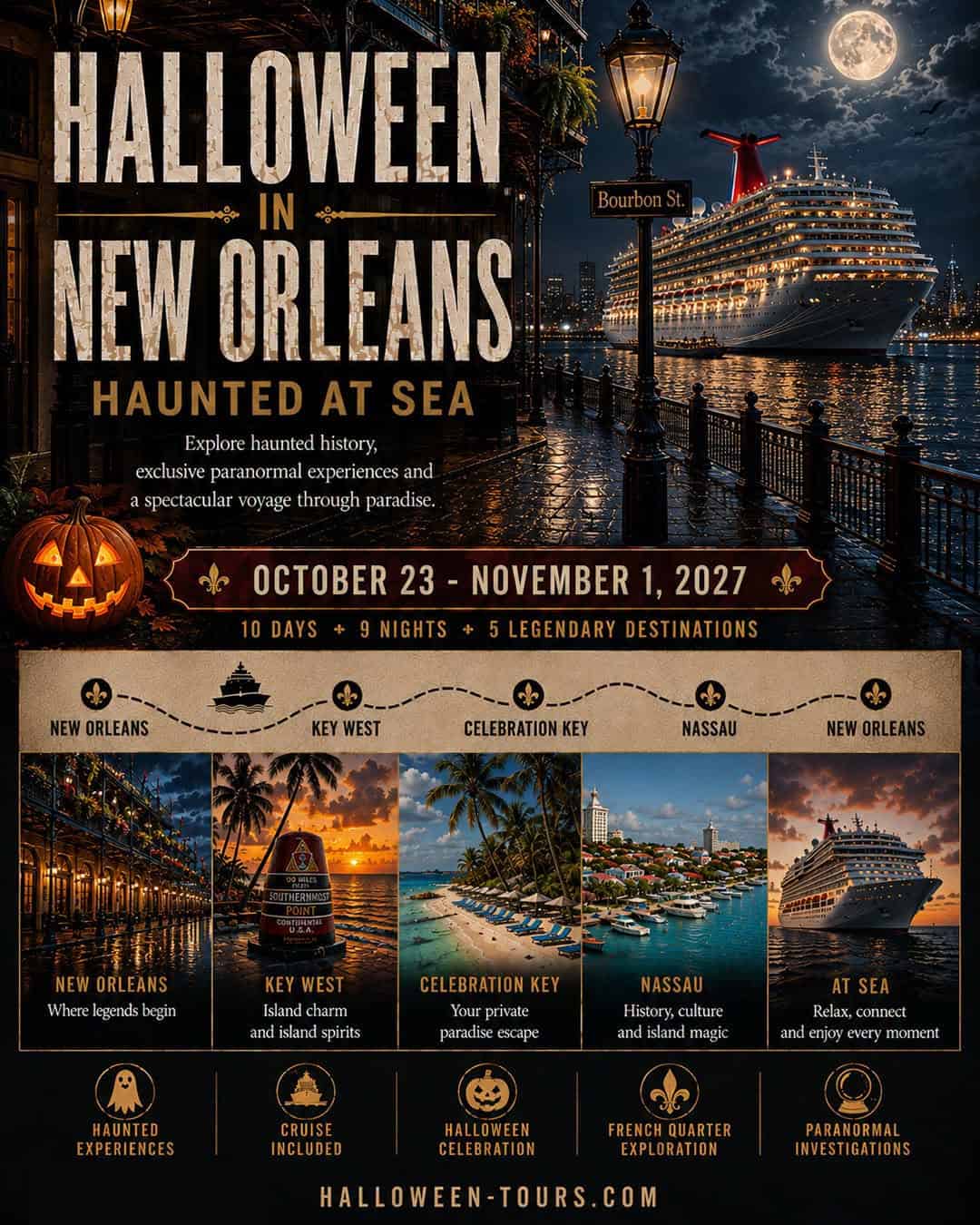
STEP INTO A WORLD WHERE HAUNTED HISTORY, HALLOWEEN MAGIC, AND CARIBBEAN ADVENTURE COLLIDE!
Haunted New Orleans & Halloween at Sea is a one-of-a-kind 10-day journey that begins in one of America’s most legendary haunted cities before setting sail aboard Carnival Liberty for a Frightfully Fun Halloween Cruise through the Caribbean. Presented by Mysterious Adventures Tours, this unforgettable adventure blends New Orleans’ haunted history, supernatural legends, vibrant culture, and iconic Halloween atmosphere with immersive experiences in Key West, Nassau, and Celebration Key. From explorations of New Orleans’ supernatural heritage to an encounter with the infamous Robert the Doll and Halloween celebrations at sea, this journey offers the perfect balance of mystery, discovery, relaxation, and festive fun.