Transformational Travel: Dark Krampus Tales
Experience the horned keeper of winter’s wildest traditions.
It was a winter evening when a little girl first met him, though not in the flesh. Her father was a postcard collector, his attic stacked with brittle boxes of correspondence from far-off lands. Some were faded photographs of cathedrals and snowy villages. Others sparkled with festivity—until she spotted a curious card in the midst of them.
She ran downstairs clutching the most terrifying image: a horned creature with wild eyes and a curling tongue, clutching birch branches in one hand and a wicker basket in the other.
“Who is this?” she asked, her small finger trembling on the horn.
Her father smiled knowingly. “Come with me,” he said, his voice low like a secret. “I’ll tell you a story.” Together they climbed the creaking attic steps, the air rich with dust and the scent of cedar boxes.
He pulled out another stack of cards. One showed Santa in a crimson coat—then another in lush green, another in midnight blue, and even one in deep brown. “Did you know,” he whispered, “that Santa wasn’t always red? Long before Coca-Cola dressed him this way, he took a spiritual journey across centuries—shifting from Odin, the wandering god of winter skies, into Saint Nicholas, and finally into the Santa we know today.”
“That’s the magic of memory,” he said. “It’s like Transformational Travel—moving not just across lands, but through time, myth, and meaning.” Then, clearing away the festive Santas, he revealed the Krampus cards beneath.
Under the glow of the attic lamp, snow began to swirl beyond the slanted windowpanes as he began the tale— one as old as Christmas itself.
Highlights
Discover what Krampus is and how you can have an incredible festival experience with Mysterious Adventures Tours!
Who is Krampus, and Why is He Part of Christmas Tradition?
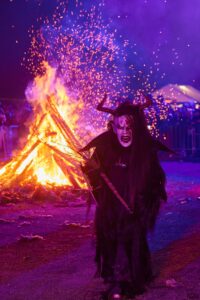
On December 5th, Krampus rattles his chains through the streets.
Before Christmas belonged to Coca-Cola reds and shopping mall Santas, winter in the Alps was darker, wilder, and more dangerous. Villages lay frozen for months, the mountains looming like white-toothed giants above the towns.
It was in these places—Austria, Bavaria, parts of Switzerland, and northern Italy—that Krampus was said to walk.
On the night of December 5th, Krampusnacht, the chains would rattle through cobbled streets. The air smelled of pine smoke and snow, but beneath it came the tang of something animal. Children would hide beneath blankets, the bite of cold air seeping into their beds, praying they had been good enough to escape his notice.
Krampus was no jolly giver of gifts. While Saint Nicholas rewarded the virtuous, Krampus punished the wicked. With his bundle of birch rods, he whipped the misbehaved; with his basket, he carried away those beyond redemption.
The girl’s father described him so vividly she swore she could hear the clink of chains outside the window.
Pagan Roots and Alpine Shadows
Folklorists trace him to pre-Christian Alpine traditions—possibly to the horned god figures of pagan Europe, protectors of the wilderness and embodiments of winter’s dangerous beauty. His horns are goat-like, his fur black as pine shadows, his tongue long and serpent-like.
The sound of his arrival was unmistakable: the drag of chains, the crunch of boots in snow, the hollow clang of cowbells worn around his waist.
Some say Krampus was once a dark spirit bound into Christian service—chained to Saint Nicholas as a symbol of the Church’s victory over the pagan wild. Others believe he remained defiantly pagan, slipping into Christian folklore without losing his primal menace.
Wherever the truth lies, Krampus survived the centuries because he was necessary. He was the shadow to Saint Nicholas’s light—the reminder that winter could be merciless, that goodness was not guaranteed but earned.
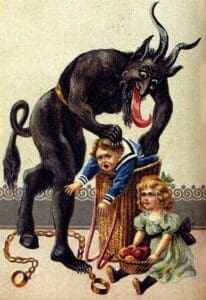
Christmas Card Depicting Krampus Punishing Children, c. 1900.
What Was The History of Krampus Postcards?
By the late 19th century, advances in steam-powered printing and lithography, combined with the growing tradition of Gruss vom Krampus (‘Greetings from Krampus’) postcards, helped popularize Krampus’s image across Central Europe. Postcards showed him chasing children, grinning wickedly, or—strangely—flirting with women.
The little girl’s father explained that these cards were part cautionary tale, part folk art. In some, Krampus was grotesque and fearsome. In others, he was strangely humorous; the darkness softened for the sake of laughter.
Yet beneath the playful veneer was an old truth: Krampus was a force to be respected.
How Does Krampus Connect to Transformational Travel?
For those who walk the path of transformational travel, encountering Krampus is not about fear—it is about reflection.
In the old Alpine villages, spiritual journeys often began with a confrontation of shadow. Krampus represents the parts of ourselves we hide away—the flaws, regrets, and misdeeds we hope no one notices. He is not evil in the sense of pure malice; he is justice, consequence, and the winter that clears the old to make way for the new.
To meet Krampus is to ask yourself: What am I carrying that should be burned away with the Yule fire?
Ready to plan an adventure of your own this Winter? Start planning the experience of a lifetime HERE!
To keep up with our blog and other Mysterious Adventures offers, sign up for our newsletter HERE!
What Makes a Krampus Festival a True Spiritual Journey?
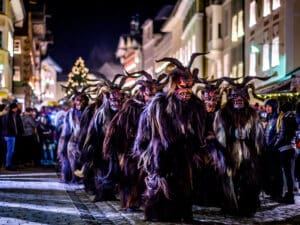
Krampuslauf or Krampus Run in Bad Toelz, Germany.
Imagine a transformational travel experience to the snow-covered streets of Salzburg or Innsbruck during the early days of December. The night is alive with the crackle of bonfires and the scent of mulled wine. Then you hear it—distant at first, then closer—the low clang of bells, the rattle of chains, and the rhythmic stomp of boots on stone.
Around the corner, a parade of horned figures bursts into view: fur-clad, masked, roaring in guttural voices. Some carry birch rods; others sway heavy baskets on their backs. Sparks leap from fire torches as they pass.
This is Krampuslauf, the “Krampus run,” where tradition blurs into living theatre. You feel the press of centuries in the air, the mingling of ancient fear and festivity. The crowd cheers, children squeal, and somewhere deep inside, you feel that primal stirring—an instinct as old as the mountains themselves.
The Cold Bite of the Lesson
The girl in the story grew up. She traveled to Austria one winter, determined to see if the creature from her father’s postcards still roamed.
She found herself in a village deep in the Alps, the snow falling in heavy, wet flakes. The night was cold enough to bite through her gloves. She stood in the town square as the Krampus procession began, her breath clouding in front of her.
The sound of the chains was just as her father described—metal on stone, rattling like distant thunder. The bells boomed against her chest, and the horned faces loomed through the snow.
She realized then that the real magic of Krampus was not in scaring children but in reminding us that every winter is a reckoning. We must face ourselves before the year turns.
A Journey for the Brave
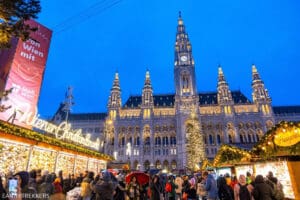
Traditional Christmas Market.
For travelers seeking more than sightseeing, following Krampus’s trail is a spiritual journey into Europe’s deep past. It is about standing in the snow where pagan ritual met Christian legend, where the cold still holds the whispers of ancestors.
It is not about horror—it is about humility.
When you walk those cobblestones and hear the chains rattle, you are not just in the present. You are in every December since the first Krampus appeared, carried forward on the breath of winter.
Krampus and the Future
In a world where winter festivals often lose their meaning under commercial lights, Krampus still stands as a raw and unpolished reminder that tradition can survive. And perhaps that is why he matters now more than ever.
Every transformational travel experience is about more than arrival—it is about what you carry home. Krampus asks you to carry wisdom, accountability, and the courage to face your own shadows.
Because in the end, the real journey is not through the snow—it is through yourself.
FAQ Section
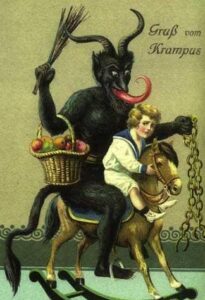
Christmas Card Depicting Krampus Punishing Children, c. 1900.
Q: What is Krampus?
A: Krampus is a legendary Alpine figure who punishes misbehaving children during the Christmas season, often appearing alongside St. Nicholas in early December festivities.
Q: Why is Krampus part of Christmas?
A: He comes from pre-Christian winter traditions and was later woven into Christian celebrations as the shadow side of gift-giving—reminding us that winter was once about survival as much as joy.
Q: How does this connect to Transformational Travel?
A: Traveling to see Krampus in his cultural homeland immerses you in centuries of folklore. It’s not just sightseeing—it’s a transformational travel experience where myth, history, and personal growth meet.
Q: What is a Krampus Run?
A: Known as Krampuslauf, it’s a parade or festival in Alpine towns where participants dress as Krampus, clanging chains and chasing onlookers in a mix of fear and fun.
Q: Where can I join a Krampus Tour?
A: Mysterious Adventures Tours offers a spiritual journey through Austria and Germany in December, including Krampus runs and evenings in historic villages where these traditions began.
Final Invitation
The attic filled with postcards is long gone now, but that little girl still keeps a special few in a wooden box. Each December, taking them out—tracing the Santa suits of red, green, blue, brown… before laying her hand on the Krampus cards. Through them, she remembers the crack of chains, the clang of bells, and that first flicker of fear that became something deeper: an invitation to transformation.
If Krampus called to you through the snow, if the chill in your bones was more than winter, you could follow where that invitation leads.
Imagine traveling with Mysterious Adventures Tours to Austria or Germany in early December—walking through lit streets where Krampus runs echo, attending traditional Krampus parades, staying in villages where folklore is still living, and gathering around blazing bonfires where stories become ritual.
This isn’t just a trip—it’s a spiritual journey through myth and memory. It’s transformational travel in its rawest form, asking us to face our shadows, celebrate our ancestral roots, and return home changed.
What are you waiting for? It’s time.
Step into a world where festive wonder meets ancient Alpine folklore!
Stroll through glittering Christmas markets, explore haunted castles like Schloss Moosham, and experience the thrilling Krampusläufe. Participate in unique cultural activities, including a Krampus Mask workshop and festive Bavarian traditions. This intimate tour promises unforgettable memories filled with history, holiday magic, and paranormal excitement!