

Venice’s Plague Islands: The Dark Secrets of Lazzaretto Nuovo
Beyond the canals and palaces of Venice, a darker history lies hidden in the lagoon.
Two isolated islands — Lazzaretto Nuovo and Lazzaretto Vecchio — once formed the front line in Venice’s battle against one of history’s deadliest pandemics.
During centuries of plague outbreaks, ships, goods, and even people suspected of infection were sent to these islands before they were allowed to enter the city. The system was designed to protect the densely populated trading capital of the Venetian Republic.
Many who arrived never returned.
Today, these quiet islands reveal something remarkable: one of the earliest organized public-health systems in the world, along with haunting archaeological discoveries that continue to reshape our understanding of plague-era Europe.
Key Takeaways
- Venice developed one of the earliest organized quarantine systems in response to repeated plague outbreaks.
- Lazzaretto Nuovo served primarily as a quarantine and inspection station for ships, cargo, and travelers entering Venice.
- Lazzaretto Vecchio functioned as a plague hospital and burial ground for infected victims.
- Archaeologists discovered a skeleton known as the “Vampire of Venice,” buried with a brick in its mouth, reflecting plague-era burial folklore.
- Today, Lazzaretto Nuovo can occasionally be visited through guided tours, while Lazzaretto Vecchio remains largely closed for archaeological protection.
Why Venice Created the World’s First Quarantine Islands
In the 14th and 15th centuries, the powerful Republic of Venice faced repeated waves of the Black Death.
As one of the most important trading hubs in the Mediterranean, Venice received ships arriving from across the eastern Mediterranean, the Ottoman world, and beyond. Trade brought immense wealth — but it also brought disease.
In response, Venetian authorities implemented a radical new strategy.
Ships arriving from regions suspected of infection were required to wait forty days before entering the city.
The term came from the Italian phrase quaranta giorni — meaning forty days — which eventually gave rise to the modern word quarantine.
Over time, this waiting period evolved into a sophisticated system of quarantine islands designed to separate the sick, inspect cargo, and protect the city’s population.
Lazzaretto Nuovo: Venice’s Quarantine Station

The abandoned island of Lazaretto Nuovo.
Lazzaretto Nuovo served as the primary quarantine station for ships arriving in Venice’s lagoon.
Cargo suspected of carrying disease was unloaded and stored in large warehouses while officials monitored both goods and travelers for signs of infection.
One of the most remarkable structures still standing on the island is the Tezon Grande, an enormous warehouse used to store merchants’ cargo during the quarantine period.
Inside the building, visitors can still see charcoal inscriptions left by sailors, merchants, and workers centuries ago. These markings recorded ship names, cargo inventories, and dates — fragments of everyday life preserved on the walls of a plague-era warehouse.
Few places in Europe offer such an immediate and human glimpse into the logistics of early epidemic control.
Haunted Castles & Dark Legends Await.
Craving a trip that immerses you in mystery and magic?
Explore our selection of tours for your next 2026 adventure!
To keep up with our blog and other Mysterious Adventures offers, sign up for our newsletter!
Lazzaretto Vecchio: The Island of Isolation
While Lazzaretto Nuovo managed quarantine and cargo, Lazzaretto Vecchio served a far grimmer purpose.
The island functioned as a plague hospital and isolation site for those already infected.
Archaeological excavations have uncovered thousands of skeletal remains buried in large plague pits across the island. These graves testify to the devastating impact of epidemic outbreaks that repeatedly struck Venice from the late Middle Ages into the early modern period.
During major epidemics, victims were buried rapidly, often with minimal ceremony, sometimes dozens within a single grave.
The archaeological record offers a stark reminder of how overwhelming plague outbreaks could become for even the most powerful cities of Europe.
The “Vampire of Venice” Discovery
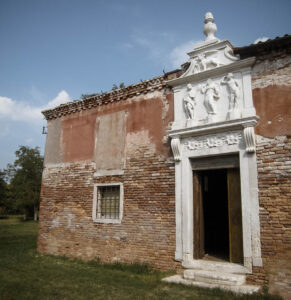
The entrance of a building on Lazzaretto Vecchio, one of the abandoned plague islands of Venice.
One of the most unusual archaeological discoveries connected to Venice’s plague history emerged from excavations at Lazzaretto Vecchio.
Researchers uncovered a skeleton buried with a brick placed inside the mouth.
Scholars believe this burial practice reflects a form of plague-era superstition. At the time, decomposition processes could produce unusual post-mortem changes in the body, which some observers interpreted as signs that the dead were somehow feeding on burial shrouds or even spreading disease from the grave.
In parts of Europe, these fears evolved into early forms of vampire folklore.
Placing an object such as a stone or brick inside the mouth was believed to prevent the corpse from rising or spreading illness.
The discovery became widely known as the “Vampire of Venice,” one of the most famous archaeological cases illustrating how fear and disease shaped burial practices during plague epidemics.
Can You Visit Venice’s Plague Islands?
Today, Lazzaretto Nuovo occasionally opens to visitors through guided tours and cultural programs.
Those who visit can explore:
- plague-era warehouses
- archaeological exhibits
- historic defensive structures
- preserved inscriptions left by sailors and workers
These tours offer a rare opportunity to walk through one of Europe’s earliest quarantine stations.
Lazzaretto Vecchio, however, remains largely closed to the public. The island continues to be protected due to its extensive archaeological remains and mass graves.
The Hidden History of Venice’s Plague Islands
Venice is often celebrated for its art, architecture, and romantic canals.
Yet the city also played a crucial role in the development of organized public health during a time when much of Europe struggled to understand epidemic disease.
The quarantine system developed in Venice influenced policies across the continent and helped shape the foundations of modern epidemic response.
The islands of Lazzaretto Nuovo and Lazzaretto Vecchio stand today as quiet witnesses to that history — places where commerce, fear, science, and survival once intersected in the fragile balance that protected one of Europe’s most extraordinary cities.

Descend into Italy’s Shadowed Past on a 7-Day Paranormal Journey with Nick & Tessa Groff
Journey into the hidden and haunted heart of Italy with Nick Groff and Tessa Groff on a re-imagined seven-day experience where beauty masks betrayal and history refuses to rest. Travel from the mist-shrouded waterways of Venice through Renaissance intrigue and medieval cruelty, uncovering plague islands, cursed castles, and dark legends woven into stone. Explore haunted estates, forbidden shores, and cities shaped by executions, inquisitions, and whispered curses before arriving in Rome, where centuries of power and sacrifice converge—and where deeper mysteries await those who choose to continue. This is not a sightseeing tour; it is an immersive passage through Italy’s shadowlands, crafted for travelers drawn to history’s hidden truths and the unexplained.


