

Myth, Blood & Mountains: A Dracula Road Trip Through Transylvania
Most people conjure images of a pale, hook‑fanged vampire when they hear “Dracula.” But the figure behind the myth—Vlad III Dracula, known as Vlad the Impaler—was a 15th‑century Voivode (prince) of Wallachia, whose brutal retributions captivated both horror and history. His name was famously adopted by Bram Stoker for the vampire count, forever entwining fact and fiction in lore and legends and fueling modern mysterious adventures.
Who Was Vlad the Impaler—and How Did He Become Dracula?
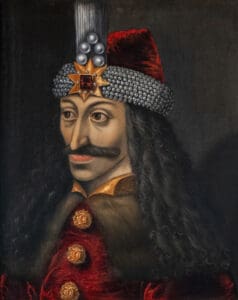
Vlad Tepes, the inspiration for Bram Stoker’s Count Dracula.
Born in 1431 in the shadowed landscape of Transylvania—modern-day Romania—Vlad III, known to history as Vlad Țepeș (Vlad the Impaler), rose to power in the principality of Wallachia during a time of relentless political upheaval. His realm was a fragile buffer state, wedged between the ambitions of the Ottoman Empire to the south and the encroaching influence of the Hungarian crown to the north. Survival demanded not just strength, but ruthlessness.
Assuming the throne multiple times amid betrayals and invasions, Vlad ruled not only as a sovereign but as a fortress of vengeance. In 1462, facing overwhelming Ottoman forces, he turned to tactics as brutal as they were brilliant: guerrilla warfare, night raids, scorched earth strategies, and poisoned wells. But his most infamous move came when he left the advancing Ottoman army a grotesque warning—a forest of thousands of impaled corpses, stretched across the battlefield like a hellish monument. The psychological shock was so profound that the invading army reportedly turned back in horror.
While these methods would etch his name into legends of terror, they also served a very real political purpose. Wallachia, plagued by feuding boyars (nobles), banditry, and foreign interference, was a land on the brink of collapse. Vlad’s brutality was, in part, a response to this chaos. He systematically crushed corruption and feudal disloyalty—on occasion, inviting treacherous nobles to lavish banquets, only to have them impaled before dessert. These acts, though draconian, brought a degree of feared stability.
To the law-abiding commoner, Vlad became not a monster, but a guardian. Stories circulated of peasants able to leave gold in the town square without fear of theft. His iron justice carved a fragile peace in a world where mercy often led to betrayal.
In this light, Vlad Țepeș is less a mad tyrant than a man forged by fire—a ruler who used terror not for cruelty’s sake, but as a calculated force of order against the disintegration of his homeland.
From History to Legend: The Birth of Dracula
Though Vlad Țepeș ruled as a flesh-and-blood prince, his afterlife in myth would transform him into something far more spectral.
Vlad’s moniker, “Dracula,” originates from his father, Vlad II Dracul, who was inducted into the Order of the Dragon—a chivalric order founded to defend Christian Europe against the Ottoman Turks. In Romanian, Dracul means “dragon,” but over time, it also took on another resonance: “the devil.” Thus, “Dracula” can be interpreted as both “son of the dragon” and “son of the devil”—a duality that perfectly foreshadows the tension between hero and horror that surrounds Vlad’s legacy.
While his reputation for impalement, psychological warfare, and cruel justice circulated throughout Eastern Europe, it was Western sources, particularly German and Slavic pamphlets, that exaggerated and sensationalized his deeds. In an age where printing was new and fear was currency, Vlad became a figure of monstrous fascination—depicted drinking blood, dining among corpses, and committing atrocities with demonic delight.
But it wasn’t until Bram Stoker’s 1897 novel, Dracula, that Vlad’s mythic transformation reached full cultural saturation. While Stoker never explicitly connected his fictional vampire to the historical prince, he borrowed the name “Dracula” and situated his character in Transylvania, thereby merging folklore, history, and gothic invention. The result was a new archetype: the nobleman turned immortal predator, the man whose thirst for power became a thirst for blood.
Thus, Vlad the Impaler passed from history into legend—not merely as a tyrant, but as a symbol of shadowed sovereignty. A ruler who bled his enemies to protect his land, and in doing so, became eternally bound to the myth of the undead.
Vampires and the Mythic Mirror

The first edition cover of Dracula, 1897. Via Project Gutenberg
The transformation from Vlad the Prince to Dracula the Vampire was not merely literary—it was archetypal. In Dracula (1897), Bram Stoker took the name and geography but left behind the man. He birthed instead a figure that speaks not to politics, but to something primal:
- The hunger for immortality
- The eroticism of danger
- The fear of being consumed
- The seduction of eternal power
- The shadow-self we dare not name
Vampires endure because they speak to our most repressed yearnings. They represent the part of us that both fears and craves the dark—the unknown within. They feed off life, yes—but they also promise forbidden freedom.
Spiritually, the vampire is an image of what happens when power detaches from soul. Vlad’s real-life descent into darkness is echoed in the myth of Dracula: power unmoored from love, sovereignty warped into hunger. And yet… we chase this myth. We dress as it, write about it, long to confront it. Why?
Because the vampire is not just other—it is us, in shadow.
And walking into the myth is, for some, a spiritual act. A reclamation of what’s been denied, feared, buried.
It is a pilgrimage into the unconscious, into the gothic chambers of our own forgotten truths.
Dare to explore Romania for yourself? Reserve your spot on our Dracula tour HERE!
Discover more about our lineup of Halloween tours for your next Fall Equinox trip HERE!
To keep up with our blog and other Mysterious Adventures offers, sign up for our newsletter HERE!
Why Explore This Story?
To visit Romania through Mysterious Adventures Tours is not ordinary tourism—it’s initiation. A spiritual journey, and transformational travel.
You’ll climb the 1,480 steps to Poenari Castle, where Vlad once ruled from jagged stone and stared down empires.
You’ll ride across mist-covered landscapes to Snagov Monastery, where the truth of his burial is debated, but the silence remains profound.
You’ll explore Bran Castle, the mythical lair of Dracula, now a cathedral of gothic imagery and tourist lore.
But beyond the stones and stories, something deeper stirs.
This journey invites you to stand in the threshold between history and legend, between the flesh and myth. It asks: What are you afraid of? What power have you denied? What part of your story still feeds in the dark?
Walking in Vlad’s footsteps, you don’t just explore a country. You confront the archetypal vampire—in the world, and in yourself. You listen to the silence of ancient monasteries, feel the wind off the Carpathians, and ask not just who Vlad was, but:
Who are you becoming when you walk through shadow and survive it?
Explore Sighisoara: Vlad the Impaler’s Birthplace
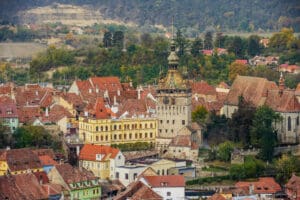
View of Sighisoara, Romania.
A highlight of any Transylvania road trip is Sighisoara, a UNESCO World Heritage Site and Vlad Dracula’s actual birthplace.
Stroll cobblestone streets, climb the Clock Tower, and visit the house where Vlad was born. It’s a place where the Dracula legend meets Romanian tradition, echoing through pastel houses and candlelit taverns.
Other Highlights of a Transylvania Road Trip
Don’t miss these stops on your journey through Dracula’s homeland:
- 🏰 Corvin Castle – A gothic jewel in Hunedoara
- 🛣 Transfagarasan Highway – Called the world’s best road by Top Gear
- ⛪ Snagov Monastery – Rumored burial site of Vlad the Impaler
FAQs About Visiting Dracula’s Transylvania
Q: What is the real Dracula Castle: Bran or Poenari?
A: Bran Castle is a popular tourist site, but Poenari Fortress was Vlad the Impaler’s real home.
Q: Is Sighisoara worth visiting on a Dracula-themed trip?
A: Absolutely! It’s Vlad’s birthplace and one of Romania’s most charming medieval towns.
Q: What’s the best route for a Transylvania road trip?
A: Start in Bucharest, visit Bran, Poenari, Sighisoara, Snagov, and drive the Transfagarasan Highway.
Conclusion: Is Dracula Fact or Folklore?
Vlad the Impaler vs Count Dracula is more than myth vs fact—it’s a mirror. A way to explore identity, shadow, and story. Through Mysterious Adventures Tours, you’ll walk in the footsteps of a prince, a monster, and a legend.
Over centuries, the horror of Vlad’s reign transmogrified into gothic legend: the vampire Dracula. That legend now orchestrates spiritual journeys through transformational travel, where truth meets terror.
To walk the steps of Poenari Castle, descend into rumored monasteries, and listen to valley air beside ancient ruins—is to chase the blood‑dark echoes of the past. To ponder what remains of a man, what survived as myth, and how stories shape the landscapes we travel—and the fears we carry. That is the truth behind the legend—and the mystery that continues to call curious souls to Romania’s haunted heart.
Whether you seek gothic architecture, hidden history, or a spiritual journey, Dracula Transylvania travel is your passage into something timeless.
🔗 Join Our Haunted Halloween Tour — Led by Dacre Stoker, Bram Stoker’s Grandnephew
🔗 Visit Mysterious Adventures Tours
 Embark on Dracula’s Haunted Halloween: A Paranormal Journey through Romania with Dacre Stoker in Halloween 2025!
 Embark on Dracula’s Haunted Halloween: A Paranormal Journey through Romania with Dacre Stoker in Halloween 2025!
Experience 12 days of eerie exploration, from Vlad Tepes’ birthplace and Peles Castle to the Halloween Vampire Ball at Bran Castle and spine-chilling adventures in Dracula’s realm. Don’t miss the private dinner at Bran Castle, a ghostly prison tour, and a thrilling climb to Poenari Fortress. Secure your spot for a Halloween like no other!
LEARN MORE >>>


