

Lammas in Ireland: Honoring the Celtic First Harvest and the Spirits of the Land
As the blazing heat of late July shimmers across the Irish countryside, something ancient begins to stir—something sacred. On August 1st, Ireland steps through a spiritual doorway into the season of harvest. Known to the Celts as Lughnasadh, Lammas is more than a festival—it’s a spiritual journey into the heart of Celtic festivals in Ireland, where fire, grain, and ancestral spirits entwine. This is the moment the land exhales, the first cut of wheat offered with reverence, setting the stage for all that is to come—including the shadowed beauty of Halloween tours in mystical Ireland.
For those drawn to ancient harvest rituals of Ireland, Lammas traditions in Celtic history, and the deep pulse of the earth’s turning wheel, Lughnasadh offers a visceral connection to Irish pagan sabbats and folklore. The fields are heavy, the air electric, and the veil begins to ripple. Now is the time to walk the old paths, invoke the old gods, and honor the phantoms and magical creatures of Celtic lore. Through spiritual tours to sacred Irish sites, you can still touch this legacy—and carry its fire into the autumn days ahead.
Highlights: From Lammas Whispers to Halloween’s Roar
If Lammas is the whisper, Halloween in Ireland is the roar—life unfolded in mythic time through the Phantoms & Magical Creatures Tour hosted by Mysterious Adventures Tours
What This Journey Offers:
- Leap Castle – Step inside the world’s most haunted castle, where I spent a night alone in the Bloody Chapel. Hear the castle’s history, walk its corridors by candlelight, and feel the generations of spirits over your shoulder.
- Haunted Forests & Forgotten Ruins – Wander through old woodlands and ancient sites seeded with centuries of folklore, where the veil still feels thin and every shadow might be something more.
- Guided Stories of Celtic Magic – Led by expert storytellers and local guardians of myth, you’ll explore lore tied to phantoms and magical creatures of Celtic lore—púcá, banshee, aos sí—and their connection to both Samhain and Lughnasadh.
- Ancestral Sites Linked to Lughnasadh – Visit places that echo both harvest and hauntings—ancient hill shrines, ritual lands, and wells where offerings once ensured bounty and avoided the Púca’s wrath.
This isn’t just a trip—it’s a living myth you get to step into. A journey that merges harvest rituals, haunted castles, ancestral spirits, and transformation.
What Is Lammas? The Celtic First Harvest Festival
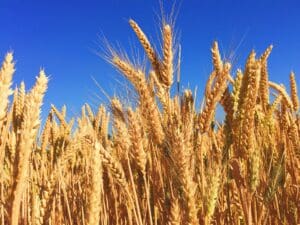
Lammas marked the beginning of the grain harvest for the Celts.
Before Halloween, there were ancient whispers of Samhain, and before Easter came Beltane and its fires, then there was Lammas — one of the four Celtic festivals in Ireland, marking the change of the cycle of the farmer’s year. In Ireland, the Lughnasadh (LOO-nah-sah) festival fell on August 1st and celebrated the first harvest of the grain crops — particularly wheat and barley — which were so important to the Celtic lifestyle. The name of the festival is derived from Lugh, the multi-talented god: master warrior, bard and poet, craftsman and king.
Lugh wasn’t just a warrior god or a bringer of inspiration—he was a solar figure, deeply connected to the ripening of the harvest and the light that made life flourish. In Irish mythology, he created a festival not to glorify himself, but to honor his foster mother, Tailtiu—a goddess of the land who gave her life clearing fields so crops could grow. Her final resting place, at Teltown (Tailten) in County Meath, became the heart of Lughnasadh celebrations. To this day, the spirit of those ancient rites can still be felt in the seasonal traditions of Lammas, carrying echoes of that sacred bond between people, land, and light through Celtic history.
Lammas marked:
- The first successful grain harvest — the literal bread of life. Loaves were ceremonially baked and offered to deities and ancestors in thanks.
- The turning of the wheel toward the darker half of the year, as the days began to shorten.
- A time of sacrifice and thanksgiving — often seen through symbolic offerings like the first sheaf of wheat or loaves of bread buried or burned.
- Community gatherings, with ritualized athletic competitions, trading, matchmaking fairs, feasting, and hilltop ceremonies intended to bring blessings from the gods and the ancestors.
- Ties to sovereignty and land magic, where rituals served as spiritual contracts between people and earth, ensuring continued abundance.
In modern Ireland, people still celebrate Lughnasadh. This happens as more people learn about Irish pagan sabbats and folklore. Some people are on a spiritual path and feel a connection to the old energies of the land. Many travel to holy Irish places; they go to Teltown, the Hill of Tara, or Loughcrew. At these places, they respect the old ways of the harvest.
Lammas was not just watching. People took part in it. Every loaf of bread, every trip up a hill along with every prayer spoken asked for divine help – these were old harvest practices of Ireland. They tied everyday living to spiritual feelings. These practices stay deep in the mythical spirit of the land.
Already feeling inspired? Discover more about our lineup of Halloween tours for your next Fall Equinox trip HERE!
To keep up with our blog and other Mysterious Adventures offers, sign up for our newsletter HERE!
Sacred Sites Still Speaking: Where Lammas Lives On
Imagine climbing a mist‑shrouded hill at dawn, the air thick with the scent of heather and blooming bilberries, the ancient land beneath your feet humming with memory. On Ireland’s Church Mountain in County Wicklow, pilgrims once gathered on Lammas Day to visit a holy well at the summit and offer the first grain of the harvest to the land’s spirits—a sacred ritual echoing the age‑old festival of Lughnasadh (en.wikipedia.org).
In County Meath at Teltown, ancient fairs called Óenach Tailten brought together community, feasting, storytelling, athletic competitions, and even matchmaking—where people honored Lugh and Tailtiu in the harmony of harvest celebrations (yourirish.com). These gatherings mirror the spirit of modern Celtic festivals in Ireland and underscore Lammas as ancient harvest rituals of Ireland that still resonate.
On Slieve Croob in County Down, locals continue to climb the mountain each Lughnasadh, carrying stones to contribute to cairns and gathering bilberries. It recalls the old custom of Bilberry (Garland) Sunday, a gesture of gratitude to the earth’s abundance and a communal ritual that still thrives today (en.wikipedia.org).
In County Carlow, St. Mullin’s Monastic Site preserves echoes of pre‑Christian pilgrimages to nearby holy wells. Once traveled by Celtic ancestors, pilgrims still visit in August to honor both Lughnasadh and its Christian counterpart, Lammas, blending old and new in a spiritual journey between worlds (en.wikipedia.org).
Across Ireland, Croagh Patrick hosts the annual Reek Sunday pilgrimage: tens of thousands climb the mountain, barefoot or carrying flowers, merging ancient Celtic reverence with modern Christian devotion—another testament to how Lammas traditions in Celtic history survive in contemporary practice.
When you wander through these sacred hills, holy wells, and seasonal fairs, you witness how Lammas lives on—not only in festivals but in Earth‑based devotion, in ritual, in remembrance, in Irish pagan sabbats and folklore made alive. These are places where the harvest becomes a blessing, the land a teacher, and every loaf of bread—from the first grain—carries the ancient promise of community, gratitude, and continuing spiritual journey.
Lammas, Legends & Liminal Beings
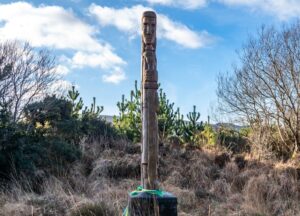
Wooden sculpture of Lugh in Dunlewey, Ireland.
The power of Lammas in Ireland stems from its nature as a time between seasons. It’s not summer, nor is it autumn yet. It occupies a threshold—a space and time in transition. In the Celtic worldview, these thresholds hold great significance. Celtic belief held that during these periods of change, the barrier separating the worlds became less solid, allowing easier access to the Otherworld, a mysterious place of spirits, deities, and magical creatures.
Lamma,s also known as Lughnasadh, has a close connection to the Wheel of the Year’s rotation, signaling the change from summer’s peak abundance toward the darker half of the cycle. Just as Samhain indicates a thinning between the realms of the living and the dead, Lammas shows a thinning between what we can and can’t see, the mortal world and the Otherworld, and what’s harvested versus what remains wild.
This quality of being “in-between” explains why people consider Lammas the spiritual relative of Samhain—it has roots in the ancient Irish worldview and sacred timing when light and dark approach balance, and pathways between worlds begin to open. These sacred days reportedly bring about more frequent and noticeable supernatural events.
Phantoms & Magical Creatures of Celtic Lore
In Irish folklore, liminal times and spaces are the favored domains of mystical beings known as the Aos Sí (pronounced ees shee)—an ancient race believed to dwell in the hollow hills, burial mounds, and stone circles scattered across the Irish landscape. These beings are not simply “fairies” in the modern sense, but rather powerful spirits, sometimes benevolent, sometimes wrathful, that require respect, offerings, and ritual to appease.
- The Púca, a shape-shifting creature often taking the form of a dark horse or goat, is said to appear around Lughnasadh. It was believed that the Púca would come after the harvest to either bless or spoil the fields, depending on whether proper offerings were made. This gives rise to the “Púca’s Share,” a portion of the crop left unharvested as a gift to the spirit.
- The Banshee (Bean Sí), though more commonly associated with death and Samhain, was thought to wander more freely during all liminal festivals, keening for ancestral spirits or warning of changes yet to come.
- Lugh of the Harvest: God of Many Faces, Lugh, the god honored during Lughnasadh, is a figure of layered and sometimes contradictory origins. Born of a complex lineage, his mother Ethniu hailed from the Fomorians—a mystical, often chaotic race associated with primordial forces—while his foster mother, Tailtiu, was a benevolent goddess of the land. This dual heritage links Lugh to both wild magic and cultivated earth, making him a liminal figure in every sense.To some, Lugh carries fae-like attributes, born of supernatural blood and skilled in all the arts: a warrior, a poet, a craftsman, and a bringer of light. Others emphasize his solar nature—his radiance and power reflecting the strength of the sun at its peak, necessary to ripen the grain and nourish both field and spirit.Lughnasadh, the festival he founded in honor of Tailtiu’s sacrifice, was more than a celebration—it was a sacred pact. Through ritual games, offerings, and storytelling, the people honored the balance between toil and abundance, sweat and sovereignty. Lugh’s presence during Lammas is not just symbolic—it is a mythic reenactment of divine reciprocity, where the land gives its bounty, and the people give thanks.
A Landscape Alive with Spirit
Ireland’s mist-covered hills, old stone forts, and holy wells still ring with this old energy. When you climb to the top of a ritual hill like Knocknashee, or stroll through a hidden glen during Lammas, you enter a living story—one where the murmurs of ancient gods ride the breeze and the glow of hidden creatures flashes just past the hedge.
Lammas makes spiritual trips to Ireland’s holy places feel extra powerful. If you leave a bit of fresh bread on a mountain peak or just walk by yourself under the full moon in August, you join in a custom that goes back thousands of years—a custom to honor, please, and awaken.
FAQs About Lammas in Ireland and the Halloween Tour
Q: Is Lammas still celebrated in Ireland today?
A: Yes, especially among neopagans, folklorists, and heritage groups. Some communities honor the sabbat with re-enactments, rituals, and traditional harvest festivals.
Q: Are there harvest symbols or traditions woven into the tour?
A: Yes. From ancient stone circles to tales of faeries and fertility, the tour touches on Ireland’s agrarian past, echoing the spirit of the harvest even as the veil thins.
Q: Is the Halloween Tour suitable for spiritual travelers?
A: Yes. The Phantoms & Magical Creatures tour blends ghost lore, Celtic spirituality, and immersive storytelling, making it ideal for seekers and sensitives alike.
Q: What should I pack for the tour?
A: Layers, waterproof gear, a journal, and an open heart. Ireland’s magic doesn’t follow a forecast.
Answer the Call of the Land
Lammas is the beginning of the end and the end of the beginning—a time to gather what’s ripe and to thank the unseen hands that help things grow. If you’ve ever longed to walk where myth and reality blur, Ireland is waiting—and Mysterious Adventures Tours will take you there.
This Halloween, come walk between the worlds. Book your tour, trace the lines of ancient magic, and meet the spirits that have never left.
👉 Reserve Your Spot for the Halloween Tour in Ireland 👈
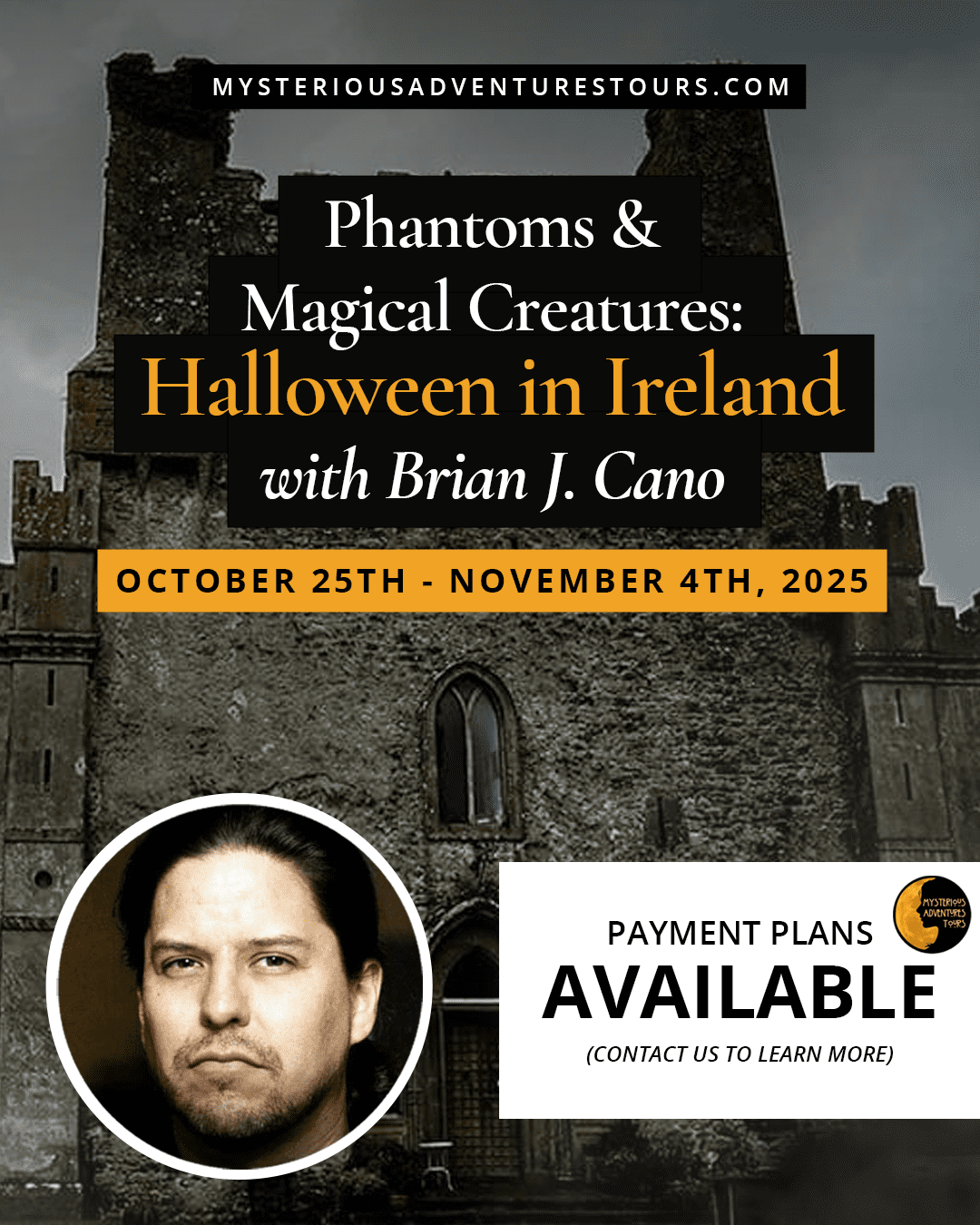
Embark on an otherworldly odyssey with Phantoms & Magical Creatures: Halloween In Ireland with Brian J. Cano!
From ancient castles to mysterious ruins, join paranormal researcher Brian J. Cano as we uncover Ireland’s most infamous haunted locations. Immerse yourself in local pubs alive with storytelling and traditional music, and indulge in hearty Irish cuisine. As Halloween night falls, prepare for supernatural exploration at haunted hotspots, conducting paranormal investigations and delving into the mysteries of the spirit world. Join us for an unforgettable 11-day journey into Ireland’s supernatural realm and discover the magic hidden within its ancient landscapes.


